


Low Countries: Crossroads of Europe from the Neolithic to the Late Middle Ages

The ‘LOCO’ project, the Low Countries: Crossroads of Europe from the Neolithic to the Late Middle Ages, is a large-scale project with strengths in applying a diachronic and transdisciplinary approach, combining history and archaeological science to explore the mobility of people, materials, and ideas. The LOCO project responds to the need for deep history, pinpointing the drivers of long-run trends in human history. A call to arms for an interdisciplinary revolution in historical research was issued in Nature in 2008, which stated the need to develop unifying theories and test them with data generated by history, archaeology, and other specialized disciplines. The LOCO project addresses this paradigm shift called for in our approach to the human past. To carry out this project, we have assembled a unique team of experts from three different universities: the VUB, the UGent, and the KU Leuven. Merging the mobility data generated in large diachronic studies, drawing from existing databases and the production of new data relating to human and commodity provenance, as well as tracing the circulation of innovations and ideas via an applied digital humanities approach.
Find out more on the project website.

Mobility of People
Within LOCO the mobility of people, commodities and ideas is studied. The ArcheOs laboratory contributes to the 'people' section of this research project. Through different analyses of human skeletal remains as well as the study of historical documents, past mobility is approached from several angles to get as complete a picture as possible.

Isotope analyses
To gain insight into lifetime mobility, isotope analyses of human teeth and bones are conducted. This includes strontium (87Sr/86Sr) and oxygen (δ18O) from tooth enamel, which gives information on someone's whereabouts during childhood, as well as sulfur (δ34S) from bone collagen which provides information on mobility from the last decade or so of an individual's life. In addition, carbon (δ13C) and nitrogen (δ15N) are also analysed from bone collagen. These two isotope systems mostly give insight into diet, which can be used as additional information. For example, if somebody had a very different diet than most of the population, then one explanation of this (among many) is that they may have lived somewhere else where diet was different, and only moved into the area in which they were buried shortly before they passed away.

Dental non-metric traits (ASUDAS)
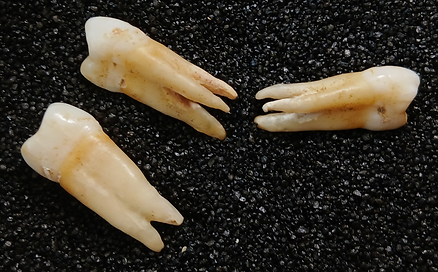
Teeth exhibit morphological crown and root traits which can vary in expression from person to person, and which can be assessed through visual inspection. These dental non-metric traits are not important for survival or selection, so they are minimally influenced by the environment. They have a strong genetic component, meaning their expression is determined to a large degree by underlying genetics. By comparing the presence frequencies of different traits between populations, it can be examined how genetically close or distant those populations are to each other. Within LOCO, dental non-metric traits of different Medieval Low Countries populations will be studied to see if and how populations changed genetically throughout the Early, High and Late Middle Ages. In order to do this, the Arizona State Dental Anthropology System (ASUDAS) will be used.

Poorterboek from Zierikzee (1302 CE) . Image from Zeeuws Archief
Citizen Registers (Poorterboeken)
From the fourteenth century (CE) onward, citizen registers are preserved from various current-day Belgian and Dutch cities. These registers (called poorterboeken in Dutch) contain information on people newly coming into the city. They vary in their level of detail and preservation, but some contain not only people's names, but also sometimes their profession and place of birth. The registered birthplaces of new citizens give information on their mobility, sometimes over a very small geographical scale. This short-distance mobility would most likely not be isotopically visible in the Low Countries, so these historical records provide additional insights. Unfortunately, citizen registers are a biased source, as women are only rarely registered and only men of a certain level of wealth are included. To combat these biases, the bioarchaeological methods described above will be used to confront the historical record.
Research Team
From ArcheOs:

Prof. Isabelle De Groote
Lieke Bes

Vrije Universiteit Brussel
LOCO is a project of:

Universiteit Gent

Katholieke Universiteit Leuven
Click here for the rest of the LOCO team
